FOR PHARMA, BIOTECH, CROS AND RESEARCH AGENCIES
Connect with relevant patients and understand their experience of disease and treatment. Chronicare supports targeted research recruitment, retrospective studies and prospective observational studies through its patient community and longitudinal patient-reported data.
RESEARCH INVITATION
Share your experience of changing treatment
A 10-minute survey from a research partner. Taking part is voluntary and you can withdraw at any time.
Not now
I’m interested
REAL-WORLD INSIGHT FROM THE PLATFORM
An aggregated view from Chronicare patient data for IBD. Patient-reported data is stratified by treatment, with anonymised treatment names and the number of patients behind every group.
Stool form by treatment
Share of logged stools by Bristol Stool Form Scale type · treatment groups with n ≥ 85 (11 of 54) · n=2,250 patients stratified by medication
Also available per group
Daily toilet visit frequency and urgency · PROMIS-derived wellbeing · Symptom prevalence · Trajectories in weeks since first log
Relevant for
Pharma and biotech: burden of disease and unmet need by treatment class. CROs and agencies: feasibility and sampling by treatment, diagnosis and country.
Aggregated, anonymised patient-reported data. Descriptive only: not adjusted for disease severity, duration or other factors, and not a comparison of treatment effectiveness.
Symptom profile by treatment
Share of daily logs reporting each symptom · treatment groups with n ≥ 50 · select a group to compare it with the others
Biologic 3 · n=136
Immunomodulator 2 · n=123
Corticosteroid 1 · n=122
Biologic 4 · n=101
Biologic 5 · n=53
Blood in stool · 18%
Mucus · 16%
Abdominal pain · 16%
Urgency · 36%
Symptom mix · Biologic 3
n=136 patients · rank among five groups
Blood in stool 18% · Mucus 16% · Abdominal pain 16% · Urgency 36%
Rank is among the five compared groups. Descriptive and unadjusted.
WAYS TO PARTNER
From a targeted research project to a tailored longitudinal programme.
01 / PATIENT ACCESS
Initial matching criteria
Denmark, Germany · Crohn’s disease · Prior advanced therapy
Matched · Opted in
Patient access
Reach relevant patients for surveys, interviews and observational studies. Identify members by geography, diagnosis and self-reported treatment history, then invite them to opt in to specific opportunities.
DELIVERABLE · Targeted recruitment and participant referrals
02 / PATIENT INSIGHTS
Two study designs
Retrospective · Existing data
Prospective · New data
Patient insights
Understand disease burden, treatment experience and unmet needs through retrospective analysis of existing logs or prospective observational studies with an agreed follow-up period.
DELIVERABLE · Cohort analyses, reports or agreed data outputs
03 / ACCESS + INSIGHTS
A tailored programme
01 Research question and cohort · 02 Community and tracking · 03 Recruitment and opt-in · 04 Follow-up, surveys and interviews
Access + insights
Build a tailored programme around your research question and target population. Combine community, tracking, recruitment and opt-in with follow-up, surveys and interviews.
DELIVERABLE · A tailored programme, including for a specific condition
Cohort availability, data coverage and deliverables are assessed for each project.
THE PATIENT PLATFORM
People use Chronicare to track symptoms, understand patterns and connect with peers who share their condition. Research builds on that ongoing relationship through relevant invitations and separate, voluntary opt-ins.
Condition-specific tracking
Designed around the symptoms and treatments of each condition.
Meaningful peer connection
Community spaces for people facing the same questions.
Study-specific research invitations
Relevant opportunities, each with its own voluntary opt-in.
Therapeutic focus
Established in IBD. Built to support other chronic conditions. Our existing community is in inflammatory bowel disease. For other chronic conditions, we scope tailored programmes with partners.
IBD · Existing community Other conditions · Scoped with partners
DATA FOUNDATION
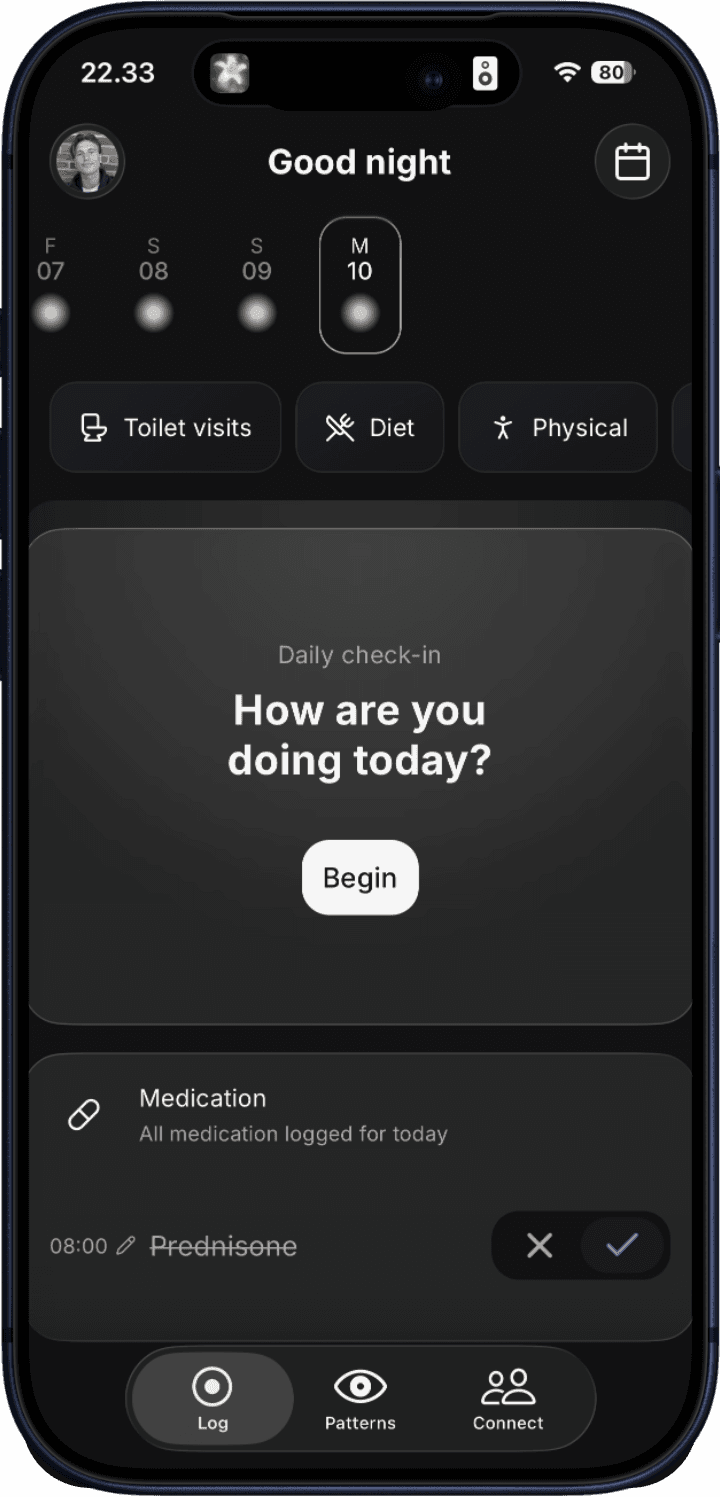
Patients log with quick, familiar inputs. Each entry becomes a structured, timestamped, patient-reported record, so patterns in symptoms, wellbeing and treatment experience can be understood over time.
Symptoms and bowel habits
Medication use and treatment changes
Physical and mental wellbeing
Diet and daily-life context
WHAT THE PATIENT SEES
How are you feeling overall today?
Poor Fair Good Very good Excellent
Which looks most like today’s stool? IBD · 1 2 3 4 5 6 7
PATIENT-REPORTED · ILLUSTRATIVE RECORD
Recorded: 2026-09-24 08:12 UTC · Wellbeing: Good (3 of 5, PROMIS-derived) · Stool form: Bristol type 6 · Symptom: Abdominal pain (SNOMED CT coded) · Severity: Moderate
Illustrative record. Field labels simplified for display. Not every health log is a validated outcome measure.
PARTNERSHIP EXAMPLE · ILLUSTRATIVE USE CASE
A pharma company wants to understand why patients with Crohn’s disease switch to and away from its advanced therapy, and how they feel before and after the switch.
01 · Scoping and feasibility
Define the therapy, switch direction, target cohort and available data.
02 · Retrospective analysis
Examine existing logs before and after recorded switches, where sufficient data is available.
03 · Prospective follow-up
Invite relevant members to opt in, then collect tracking data and questionnaires from enrolment onwards.
04 · Qualitative interviews
Explore why patients switch, what they expected and how they experience the change.
STUDY DESIGN: ONE SWITCH, BEFORE AND AFTER · ILLUSTRATIVE
BEFORE THE SWITCH · Existing logs, retrospective
AFTER THE SWITCH · New data, prospective
Existing logs show how members felt before and after a switch, where they were already tracking. From enrolment, new tracking data, questionnaires and interviews are added.
OUTPUTS
How reported symptoms and wellbeing compare before and after switching · Why patients switch, in their own words · Insight to inform medical affairs, market access and brand strategy
CONSENT AND GOVERNANCE
Patient trust is what makes the platform work. We are transparent with members about how research partnerships operate and how their data is used. Chronicare ApS is based in Copenhagen and operates under the EU General Data Protection Regulation.
Separate consents
Consent to data use and consent to study participation are distinct, and members give each separately.
Voluntary participation
Taking part in research is voluntary and never determines access to the Chronicare app.
Clear data provenance
Data are patient-reported observations and are presented as such, alongside rather than in place of clinical data.
Agreed per project
Cohort feasibility, data coverage, delivery format and permissions are agreed for each project.
Tell us your research question, therapeutic area and target population. We’ll discuss feasibility and how Chronicare could support your project.
